
In 1888, Heinrich Heinz developed what is considered the first radio transmitter, a device that could transmit radio waves wirelessly. Afterwards, Guglielmo Marconi added a high conductor and a ground connection to this transmitter.
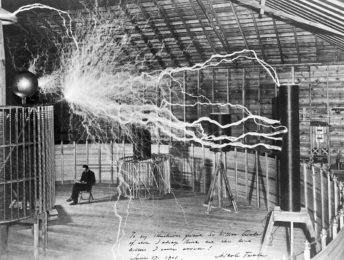
At the same time, Nikola Tesla was also working on radio transmission. He made his own transmitter, with an instantaneous power five times greater than that of his predecessors. Tesla deeply believed in a future world coming to life through wireless energy. He says, “When wireless is perfectly applied the whole earth will be converted into a huge brain, […]. We shall be able to communicate with one another instantly, irrespective of distance. Not only this, but through television and telephony we shall see and hear one another as perfectly as though we were face to face, despite intervening distances of thousands of miles; and the instruments through which we shall be able to do his will be amazingly simple compared with our present telephone. A man will be able to carry one in his vest pocket”. In 1897, he established the foundation for radio technology by building a radio station capable of transmitting signals more than 40 km away. Then in 1901, he built a transmission tower on Long Island that was never completed. Tesla envisioned this tower to be able to transmit wireless signals across the Earth, anywhere. It was to be used for both telephony and commercial transatlantic wireless broadcasting, and to demonstrate the possibility of wireless power transmission. But in 1917, the tower was not fully operational and was destroyed. Industrialists stopped all financing, not seeing the benefit of free energy.


